

Since 2017, work has been underway on the conservation and restoration of the Prince’s Rooms at Hohensalzburg Fortress. In order to restore missing sections in the wooden paneling of the magnificent Golden Chamber as authentically as possible while preserving the original materials, Salzburg Burgen and Schlösser, the project developers BAUKULTUR2, Salzburg University of Applied Sciences, and the Federal Monuments Authority have collaborated closely to develop and implement a unique and innovative method. By using 3D scanning technology, computer-aided manufacturing, and sustainable wood-fiber composite materials, the damage was repaired without additional intervention in the historically valuable structure. After the 3D-printed inlays were precisely fitted through skilled restoration work, the Golden Chamber now shines once again in a “new-old” splendor.
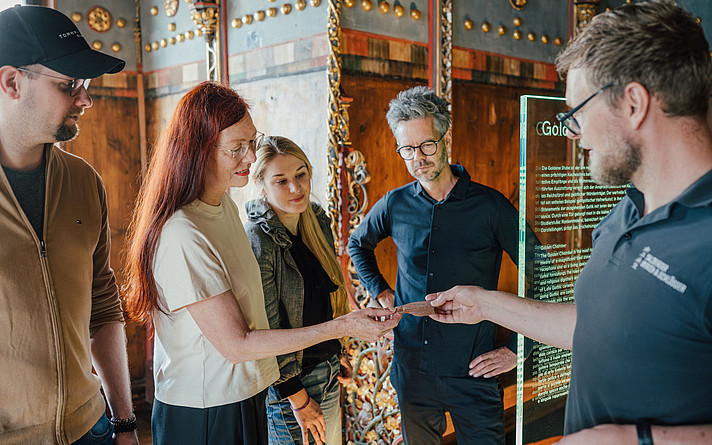
Hohensalzburg Fortress, dating back to the 11th century, is a landmark in the heart of Salzburg’s Old Town. With around 1.5 million visitors in 2025, it is one of the most visited attractions in Austria. Since 2017, intensive work has been underway on the conservation and restoration of the magnificent Gothic Prince’s Rooms, which—with the Golden Hall, Golden Chamber, and Bedchamber—form a globally unique ensemble of ceremonial rooms. During the restoration of the Golden Chamber, two areas of loss were identified in the wooden paneling, in addition to extensive work on wall surfaces, carvings, sculptures, and decorative elements. However, none of the previously known restoration methods proved ideal for repairing this damage.
“As one of our central responsibilities is to sustainably preserve Salzburg’s castles and palaces as significant monuments, we decided to pursue new and creative approaches in collaboration with forward-looking partners and authorities and to rely on innovative technologies,” explains Maximilian Brunner, Managing Director of Salzburger Burgen und Schlösser Betriebsführung.
Markus Mackinger from the construction management team at Salzburger Burgen und Schlösser adds: “Construction management at Salzburger Burgen und Schlösser requires a passion for craftsmanship and historically proven building methods. At the same time, it is about developing new ideas and finding modern solutions that take into account the historical fabric while also considering today’s technological possibilities.”
From idea to practical application
Initial discussions between Salzburger Burgen und Schlösser, the project development office BAUKULTUR2, and Salzburg University of Applied Sciences took place at the end of March 2025. As part of the FH project EDIH innovATE, potential digitalization applications for the restoration of the wooden paneling in the Golden Chamber were explored. A feasibility study on the restoration of missing elements in historic buildings served as a practical use case. Following the initial investigations, development and implementation of the project were taken over by SCSM 2.0, the Salzburg Center for Smart Materials.
Precise restoration using digital twins
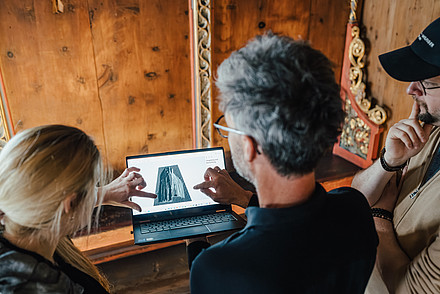
The project was ultimately implemented in practice at the Department of Design and Green Engineering at Salzburg University of Applied Sciences in cooperation with BAUKULTUR2. In a first step, the damaged area in the wooden paneling of the Golden Chamber was recorded non-destructively and with millimeter precision using a mobile 3D scanner. This process created a virtual representation of the missing section. Based on these data, a digital positive model—a so-called digital twin—was generated, forming the basis for producing a precisely fitting inlay.
Vision: Printing wood for heritage conservation
The inlay was produced using FDM 3D printing (Fused Deposition Modelling) from a specially developed filament made of sustainable, bio-based materials, including natural wood fibers and a green thermoplastic binder. The materials used are largely derived from residual products of agriculture and forestry. Thanks to the natural fibers, the material exhibits hygroscopic properties and responds to changes in humidity in a way similar to solid wood. In this way, digital twins were transformed into inlays made from sustainable materials that can integrate precisely into existing historic wooden surfaces.
The project at Salzburg University of Applied Sciences was led by Stefan Kain, who specializes in the use of biogenic materials in 3D printing. “Our goal was to integrate digital technologies into restoration in a way that respects the material and the historical original. Through sustainable materials and precise 3D printing processes, new pathways are emerging for preserving cultural assets without damage and with efficient use of resources,” says Kain.
Thomas Trattner, Managing Director and co-owner of BAUKULTUR2 GmbH, adds: “What began as a spontaneous idea—namely ‘printing wood’—has developed into a novel approach for supplementing missing elements in historic wooden interiors. The project combines craftsmanship, research, technology, and heritage conservation, opening up new supportive methods in wood restoration.”
Traditional craftsmanship meets cutting-edge technology
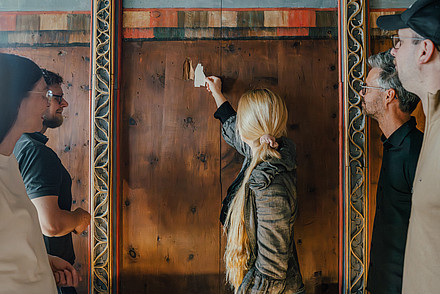
Finally, the digitally created and 3D-printed inlay was finished using traditional restoration craftsmanship: “As part of testing the material properties of the 3D-printed wood-fiber composite, we were able to trial reversible bonding methods as well as techniques for surface finishing and retouching. Through thermal structuring and color matching, we were able to integrate the inlay seamlessly into the historic environment. In other words, this was a model project demonstrating how digital manufacturing techniques can be perfectly combined with restoration requirements such as material compatibility and reversibility,” explains Florentina Woschitz, restorer at Salzburger Burgen & Schlösser.
A model project for heritage conservation
For many years, the Salzburg Regional Conservation Office and the Department for Conservation and Restoration have been closely supporting the restoration of the Prince’s Rooms at Hohensalzburg Fortress in collaboration with Salzburger Burgen und Schlösser Betriebsführung, in accordance with current conservation and restoration standards.
The Federal Monuments Authority also closely accompanied the 3D project from the very beginning and assessed the innovative technology with regard to its compliance with current restoration standards.
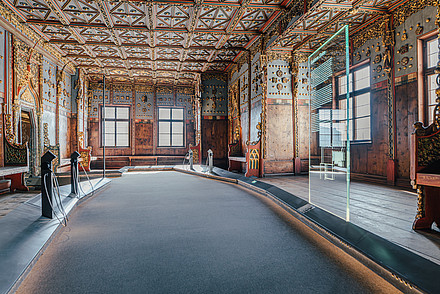
“The conservation and restoration measures on the woodwork of the Golden Chamber aimed to achieve a well-maintained and aesthetically convincing appearance that respects and makes visible the material’s age value and historical authenticity. For two visually disruptive areas of loss, BAUKULTUR2, together with Salzburg University of Applied Sciences at the Kuchl campus, developed an innovative method for producing precisely fitting inlays—without any additional loss of historical substance. Following expertly executed retouching craftsmanship, the additions meet all heritage conservation requirements. Here, cutting-edge 3D technology, traditional craftsmanship, and centuries-old cultural heritage come together,” explains Eva Hody, State Conservator for Salzburg.
As part of this innovative and previously unique project, it has now become clear that this new methodology offers significant advantages in the field of heritage conservation: while conventional restoration methods often require damaged areas to be enlarged in order to create precisely fitting additions, digital manufacturing enables the exact reconstruction of even highly complex missing sections—without further loss of historical substance.
Hohensalzburg Fortress thus stands as a prime example of a new approach to restoration—precise, sustainable, and respectful of the object’s history.
Photos: © Salzburger Burgen & Schlösser / Kathrin Gollackner